July 2, 2026 • 4 min
The Surprising Invention Behind Every Modern Credit Card

Matthew Magnus
Creative Producer

Rick Chen
Spokesperson
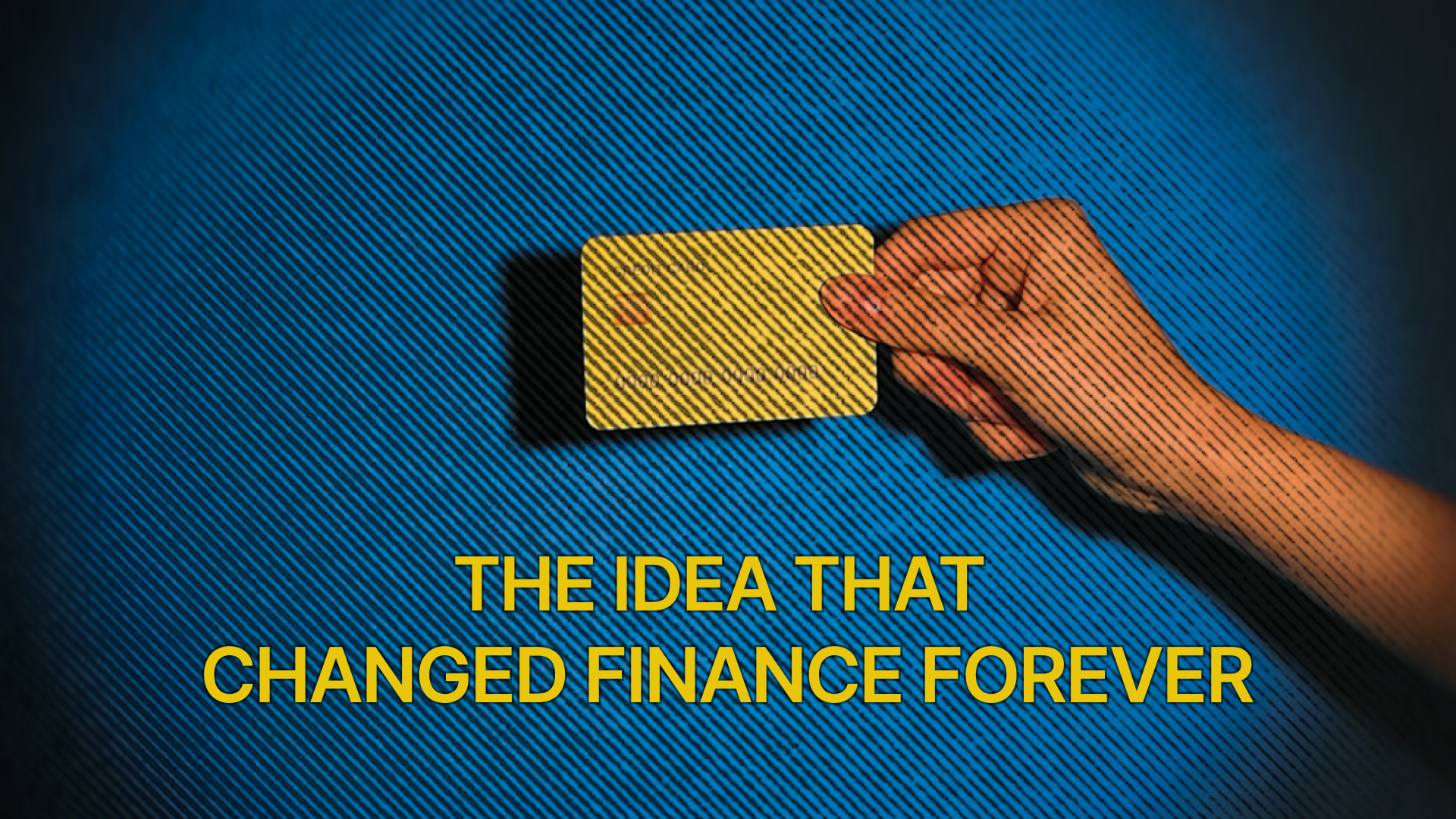
Millions of people carry a credit card in their pocket every day, but few likely stop to think about how they work or why they might look the way they do.
The first credit card was simple. It was made from cardboard. Merchants copied and kept account information for billing by hand. It was also a charge card, so cardholders had to pay off balances in full each month. Transactions were slow, and it didn’t scale as a mass payment system. Only a few restaurants in New York City even accepted the card.
It wasn’t until 1960 that payment cards started to look like the credit cards we know today.
An IBM engineer named Forrest Parry needed to figure out a way to attach magnetic tape to a plastic card so that it could store data. His idea was promising, but he struggled to find a good way to attach the tape without damaging it. His wife provided the breakthrough.
One evening, Parry’s wife, Dorothea, suggested using a laundry iron to bond the magnetic stripe to the plastic card. The idea helped make the magnetic stripe card possible, a technology that banks and credit card issuers around the world would later use.
Within a few years, magnetic stripes became a standard feature on payment cards and, with it, the foundation of modern consumer finance was established.
In this episode of “Footnotes of Finance,” Aven tells the story of how a household iron helped make modern credit cards and modern electronic payments possible.
What is the history of the credit card?
The history of the credit card can be traced back to the Diners Club card. In 1949, Frank McNamara invented and introduced the charge card so that diners could make purchases and pay the balance later.
Who invented the credit card?
Frank McNamara and his Diners Club card is widely regarded as the first charge or credit card.
Forrest and Dorothea Parry are credited with helping invent the magnetic stripe technology that transformed how payment cards worked.
Who invented the magnetic stripe credit card?
Forrest and Dorothea Parry are widely credited with helping invent the magnetic stripe card. According to a widely told story, Forrest’s wife, Dorothea, suggested using an iron to attach magnetic tape to a plastic card.
When was the magnetic stripe credit card invented?
IBM developed magnetic stripe card technology in 1960. Forrest and Dorothea Parry’s engineering technique and IBM’s technology became widely adopted by credit card companies soon after.
What is a magnetic stripe credit card?
A magnetic stripe credit card has a strip of magnetic material that stores account or card information. Card readers and other technology read the information on the card quickly, helping merchants process payments more efficiently.
Why did credit cards have a magnetic stripe?
The magnetic stripe on credit cards help make payment processing faster and more reliable.
Before the magnetic stripe, transactions were processed manually. Payment card information was manually copied and stored for recordkeeping, which led to slow payments and, sometimes, fraud.
How did credit cards work before magnetic stripes?
Early credit cards relied on paper records and other manual processing to accept, record and bill purchases. Magnetic stripe credit cards helped make accepting cashless payments easier, more efficient and scalable.
Are magnetic stripe credit cards still used today?
Yes. Many credit cards still include magnetic stripes. Modern credit cards also have chips and other technology to support contactless payments and other card features.
What replaced the magnetic stripe credit card?
Many modern credit cards have a chip called an EMV chip in addition to a magnetic stripe. EMV stands for Europay, Mastercard and Visa, the companies that invented the technology and developed the payments standard.
EMV chips help make card payments more secure and efficient by creating unique transaction data for every purchase.
Watch the full video: The Surprising Invention Behind Every Modern Credit Card
“Footnotes of Finance” explores the inner workings of the consumer finance industry. Every financial product has an origin story, and Aven breaks down the real story of how things work.

Video transcript: The Surprising Invention Behind Every Modern Credit Card
What credit card should I get? Who has the best rewards, travel, cash back, benefits?
Everyone’s optimizing the credit card, but nobody’s actually asking where it even came from.
The modern credit card came from one idea in a couple’s kitchen in 1960.
But let’s start at the beginning. In 1949, Frank McNamara invented the Diners Club card after forgetting his wallet at a restaurant. He revolutionized consumer finance with the concept of buy now, pay later, but the process was slow and imperfect. There needed to be a foolproof, efficient way to transfer your account data instantly.
Enter Forrest Parry, an IBM engineer who was tasked with a classified CIA project: attaching magnetic tape to a plastic card to store encrypted identity data. He’s one of IBM’s best engineers, but he couldn’t crack it. Every glue he tried would destroy the tape.
So, one night, he comes home to his wife, Dorothea, doing laundry and tells her the problem.
She picks up the iron. “Use this.”
Of course, Parry was skeptical at first, but, out of time and out of options, he goes for it. And, to his surprise, it actually worked.
And Dorothea’s simple suggestion accidentally invented the backbone of our entire modern payment system.
Banks adopted it. Visa built on it, and eventually, every single credit card on Earth carried it.
Here’s the part worth sitting with: We spend enormous amounts of energy optimizing systems we’ve completely stopped questioning. Nobody asks what the thing actually is, where it came from, and whether there’s a better version sitting right in front of us.
Every system you trust was once just someone’s unconventional idea that just happened to work.


© 2026 Aven
Aven accounts are arranged by Aven Financial, Inc., dba "Aven" (or "AvenCard" in AR, ID, and PA). NMLS #2042345. See aven.com/licenses for licensing info.
Aven Visa Credit Cards are issued by Coastal Community Bank, pursuant to a license from Visa U.S.A., Inc. Aven accounts are made by Coastal Community Bank, Member FDIC. Equal Housing Lender. NMLS #462289 (NMLS Consumer Access Page). For additional information or complaints to Coastal Community Bank, visit www.federalreserveconsumerhelp.gov. For more information, you can also visit Coastal Community Bank’s privacy policy.
Apple and the Apple logo are trademarks of Apple Inc., registered in the U.S. and other countries. App Store is a service mark of Apple Inc., registered in the U.S. and other countries. Google Play and the Google Play logo are trademarks of Google Inc.
Aven
548 Market St #99555
San Francisco, California 94104
support@aven.com