August 13, 2026 • 3 min
How a Failed Cable Connected the World

Matthew Magnus
Creative Producer

Rick Chen
Spokesperson

Your credit card seems to work almost instantaneously. Each time you swipe your credit card or make an international purchase online, there’s a good chance your payment data travels across a vast network of submarine fiber-optic cables in milliseconds.
This is all possible thanks to one of the most ambitious engineering projects of the 19th century.
In the 1850s, Cyrus Field set out to connect North America and Europe with a telegraph cable laid across the Atlantic Ocean.
Fields failed multiple times. His cables snapped again and again. He lost funding for his company, but he persevered. In 1866, Field’s company tried again with purer copper and thicker insulation, and the project finally succeeded.
The achievement became the first of many infrastructure projects that would eventually help make the modern internet possible and transform global commerce.
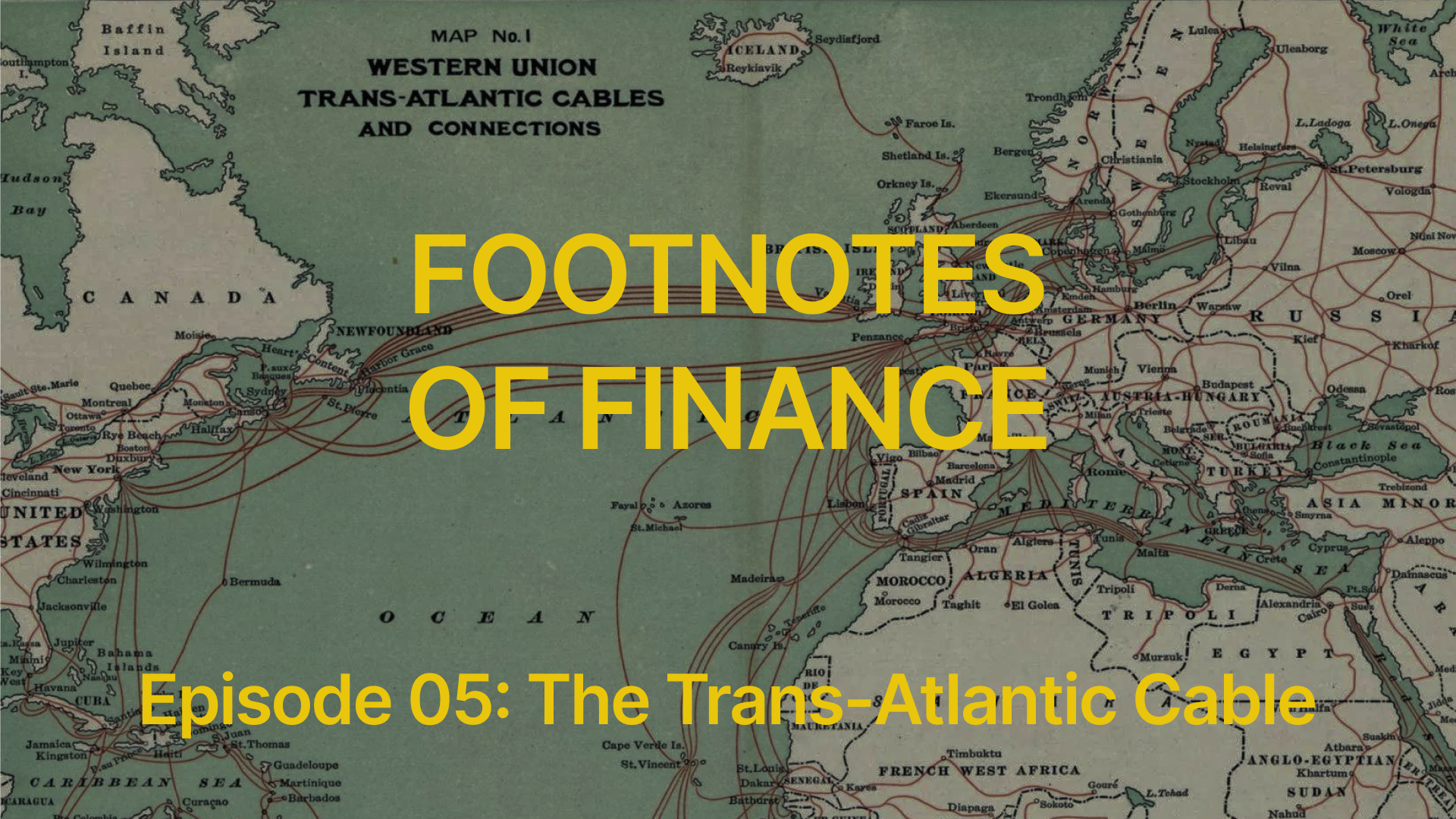
In this episode of “Footnotes of Finance,” Aven explores how Cyrus Field’s ambitious project helped shape the modern internet and reshape finance and communications at the same time.
What was the transatlantic telegraph cable?
The transatlantic telegraph cable was an undersea communications line connecting North America and Europe. Once completed, telegraph messages could cross the Atlantic Ocean much faster.
Who built the first transatlantic telegraph cable?
The American businessman Cyrus Field and his Atlantic Telegraph Company are credited with building and laying the first transatlantic telegraph cable.
Field’s company also received support from various investors and the British and U.S. governments.
When was the first transatlantic telegraph cable completed?
The first transatlantic telegraph cable was completed in 1858, but failed after a few weeks. A stronger, more permanent transatlantic telegraph cable was laid and operational beginning in 1866.
Why was the transatlantic telegraph cable important?
The transatlantic telegraph cable helped make international cooperation and commerce quicker and more efficient, particularly between Europe and North America. The faster communication helped integrate economies worldwide.
What is the connection between the transatlantic telegraph cable and the internet?
A lot of today’s internet depends on the same routes and concepts as the first transatlantic telegraph cables. Modern internet infrastructure uses thousands of miles of submarine fiber-optic cables to carry data.
Watch the full video: How a Failed Cable Connected the World
“Footnotes of Finance” explores the inner workings of the consumer finance industry. Every financial product has an origin story, and Aven breaks down the real story of how things work.
Video transcript: How a Failed Cable Connected the World
Every time you swipe your credit card, it’s pretty much instantaneous. You can buy something from the other side of the world, and it just works. How?
With hundreds of miles of fiber-optic cables laid across the ocean floor, a concept that one man pioneered over 150 years ago.
The year is 1854. A paper merchant named Cyrus Field had a big idea. He believed that he could be the one to expand the already-existing telegraph technology to heights that the world had never seen: one transatlantic working cable that won’t just speed up finance, it’ll reshape commerce, communication and create a connected world in real time.
The only problem, though: He’d never built a telegraph in his life.
But with great confidence, he formed his company, The Atlantic Telegraph Company, in November 1856.
Soon, they had 2,500 nautical miles of cable ready, but it was so heavy, no ship on Earth could carry it whole, so he had to split it between two naval ships. By August 1857, and with almost his entire life’s fortune on the line, they set off for the first attempt.
For the first attempt, he tried to lay it across the Atlantic floor, and it snapped after 335 miles.
A year later, in 1858, he tried again. This time, he had the ships meet in the middle and sail in opposite directions. The cable remained intact, but it was only online for about three weeks until it died.
Then, the Civil War hits, and his funding disappears for years.
But fast forward to 1865: He’s back. And with the new cables aboard the largest ship ever built at the time, the cable breaks again, 1,200 miles from where it had been laid.
1866, attempt number five: This time, the cable was built stronger with purer copper at the core, wrapped in thicker layers of insulation, and this time it landed.
And since then, that idea has never stopped evolving. Today, firms pay hundreds of millions of dollars to lay fiber-optic cables under that same ocean to stay ahead of their competitors, even by just a few milliseconds.
All of it built on a route that one man refused to give up on.


© 2026 Aven
Aven accounts are arranged by Aven Financial, Inc., dba "Aven" (or "AvenCard" in AR, ID, and PA). NMLS #2042345. See aven.com/licenses for licensing info.
Aven Visa Credit Cards are issued by Coastal Community Bank, pursuant to a license from Visa U.S.A., Inc. Aven accounts are made by Coastal Community Bank, Member FDIC. Equal Housing Lender. NMLS #462289 (NMLS Consumer Access Page). For additional information or complaints to Coastal Community Bank, visit www.federalreserveconsumerhelp.gov. For more information, you can also visit Coastal Community Bank’s privacy policy.
Apple and the Apple logo are trademarks of Apple Inc., registered in the U.S. and other countries. App Store is a service mark of Apple Inc., registered in the U.S. and other countries. Google Play and the Google Play logo are trademarks of Google Inc.
Aven
548 Market St #99555
San Francisco, California 94104
support@aven.com