August 20, 2026 • 5 min
How to Pay for College With Your Credit Card

Matthew Magnus
Creative Producer

Paying for college is one of the biggest expenses for most families. While federal and private student loans are good, obvious options, homeowners may have another option: borrowing against the equity in their home.
In this episode of “Equity 101,” we break down how a HELOC can be used to help pay for eligible college expenses, how the interest rates can compare with other types of borrowing and what homeowners should consider before using home equity to pay for tuition. We also look at how bitcoin holders may be able to borrow against their holdings instead of selling them.
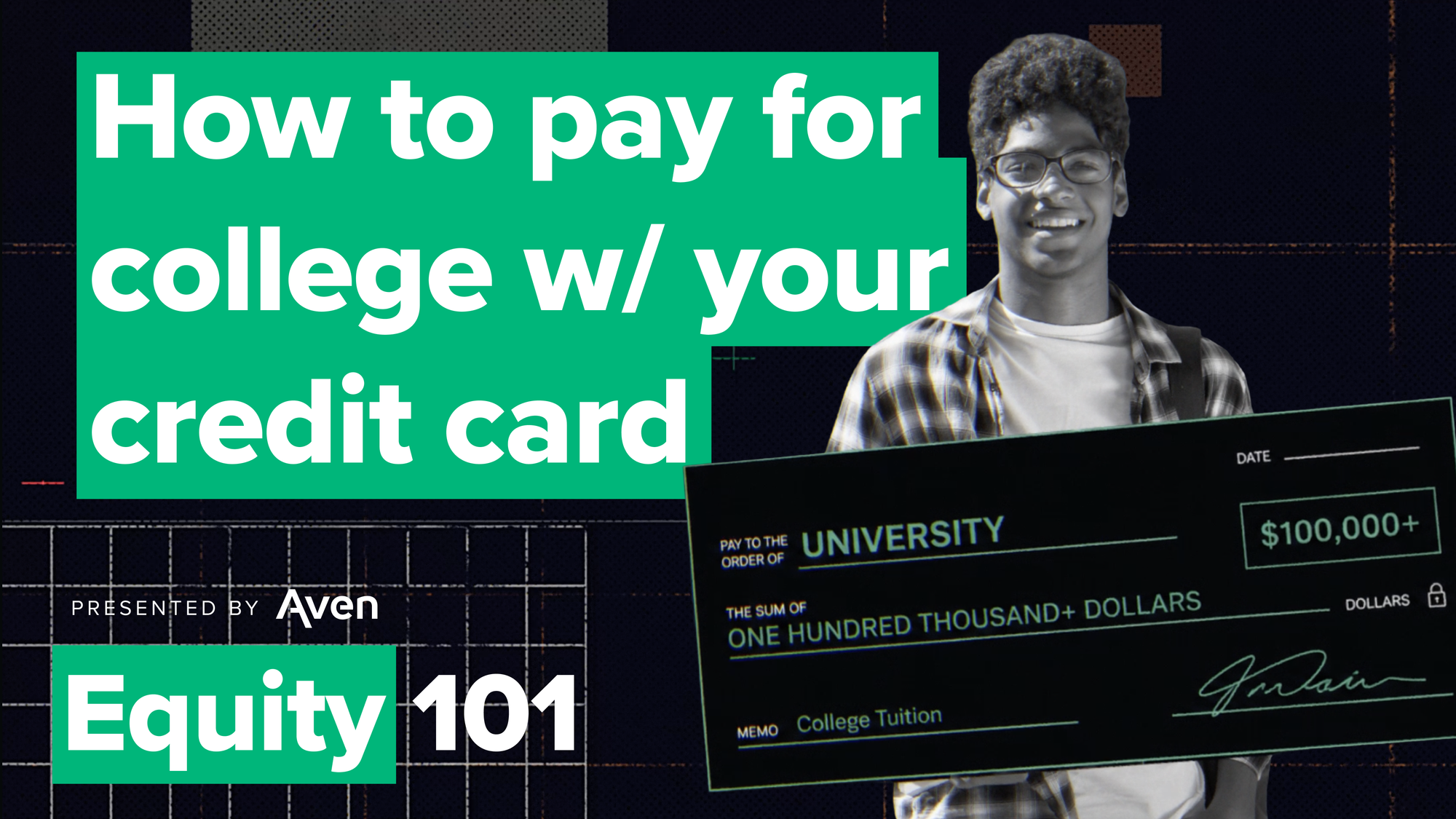
Watch the full video: How to Pay for College With Your Credit Card
“Equity 101” breaks down the concepts, terms and decisions that matter most to homeowners. Being a homeowner doesn’t have to be hard, and understanding your finances doesn’t have to be confusing. Aven explains everything that you might want to know.
Video transcript: How to Pay for College With Your Credit Card
What if the most valuable thing about owning your home wasn’t the house itself? But it was how you could use it to pay for some of life’s biggest expenses.
This is “Equity 101.”
After buying a house, sending a child to college is probably the biggest check most American families will ever write, and we’re not talking about a one-time thing.
In the U.S., the average private university tuition is $45,000 per year. Public in-state is around $11,950, and that’s just tuition. When you add housing, supplies and everything else, you’re at $30,000 a year for a public and $62,000 for private—every year for four years.
And those numbers have more than doubled since 2000, climbing about 4% every single year.
So how do people actually pay for this?
Of course, savings, financial aid and loans are some of the options that come to mind for most people, but there are options most families may not look at that could actually save you a significant amount of money.
Let’s dive in.
Federal loans are usually the starting point and for good reason. Undergrad APRs are around 6.38% as of the date of this video. Parent PLUS loans are at 8.94%, and they come with real protections, too—income-based repayment, deferment options—stuff that private lenders don’t offer.
But here’s the thing: Federal loans have a borrowing cap, and most families hit that cap. And when they do, they might get a private loan, and the interest on private loans can potentially run up to 17%.
Think of it this way: A $50,000 loan, at say, 14% over 10 years costs you roughly $93,000 by the time you’re done. You borrowed $50,000, but you paid back almost double. That’s the part that nobody puts in the brochure.
But here’s where it gets interesting.
If you own a home, you may be sitting on more financial flexibility than you realize, and most people never think to use it for something like this.
U.S. homeowners collectively hold a record of around $17.8 trillion in home equity right now, and the average homeowner has around $213,000 in accessible equity—that’s money tied up in the walls of your house, and you can borrow against it without selling.
It’s called a HELOC, or a home equity line of credit.
And what’s great about a HELOC is that the national average HELOC APR is around 7.43% right now. The only thing is that traditional HELOCs can be slow, require tons of paperwork; they take weeks to approve and often require an appraisal.
But what if your HELOC could act like a credit card, backed by your home and approved in as little as 15 minutes?
That’s the idea behind the Aven Home Equity Card. It’s the same concept as a HELOC, but it works as a Visa card. You can use it anywhere, including eligible tuition payments.
Rates on the Aven card currently run as low as 7.49% for qualifying borrowers. Compare that to the average credit card APR of 21.52%, and that’s a huge difference! And you can earn unlimited 2% cash back on purchases.
That’s the difference between paying roughly $10,000 a year in interest on a $50,000 loan versus only $3,500 to $4,500.
Instead of taking a private loan out at 14% APR, a homeowner might be able to borrow at roughly half that rate. And on $50,000, that difference adds up to tens of thousands of dollars over the lifetime of a loan.
You do need to own a home for this to work, but, if you’re already looking at a private loan with a high rate, then this is absolutely a comparison worth making.
This next option is for a very specific group of people, but if it applies to you, it’s a genuinely smart thing to know about.
Say you bought bitcoin a few years ago. Tuition is due, so you think, okay, I’ll just sell some and cover the bill.
But here’s the catch: Selling bitcoin could be a taxable event. The IRS treats it like selling a stock, so now you’re just not paying your university, you’re also handing a chunk of your gains to the government, too.
But the Aven Bitcoin Visa Card is a bitcoin-backed line of credit. Instead of selling, you borrow against your holdings. No sale means no taxable event, and the value of your bitcoin stays intact.
It also offers fixed-rate repayment terms of up to 10 years, so you’re not scrambling to cover a huge bill all at once, and it earns 2% cash back on eligible purchases.
So, if you’re a person who’s been holding bitcoin for years, and you don’t want to give up your future gains just to write a tuition check, this is exactly what it was built for.
A couple things to keep in mind: Using any credit card and carrying a balance long-term for tuition is expensive. Credit cards aren’t built for multi-year repayment the way student loans are.
The Home Equity Card is structurally different, but the point still stands. Be sure to read the terms, know your rate, and make sure it works for your situation.
And one more thing: Some schools that accept credit card payments could charge a convenience fee, so it is worth a quick call to your billing office before you pay.
Most families spend four years carefully choosing a college and then about four minutes figuring out how they’re going to pay for it, but now you know there are more options on the table.
Check to see if you qualify at Aven.com. Terms and conditions apply.


© 2026 Aven
Aven accounts are arranged by Aven Financial, Inc., dba "Aven" (or "AvenCard" in AR, ID, and PA). NMLS #2042345. See aven.com/licenses for licensing info.
Aven Visa Credit Cards are issued by Coastal Community Bank, pursuant to a license from Visa U.S.A., Inc. Aven accounts are made by Coastal Community Bank, Member FDIC. Equal Housing Lender. NMLS #462289 (NMLS Consumer Access Page). For additional information or complaints to Coastal Community Bank, visit www.federalreserveconsumerhelp.gov. For more information, you can also visit Coastal Community Bank’s privacy policy.
Apple and the Apple logo are trademarks of Apple Inc., registered in the U.S. and other countries. App Store is a service mark of Apple Inc., registered in the U.S. and other countries. Google Play and the Google Play logo are trademarks of Google Inc.
Aven
548 Market St #99555
San Francisco, California 94104
support@aven.com